
An Estate Cleanout Checklist for Huntsville Families
Clearing out a family home is rarely simple, and it's almost never just about the stuff. Here's a practical checklist to help you sort, decide, and size the job — one step at a time.
Huntsville dumpster guide
Construction and demolition debris behaves differently than household junk — weight adds up fast, and the right size depends more on material type than square footage. Here's how to plan a job-site dumpster the right way.
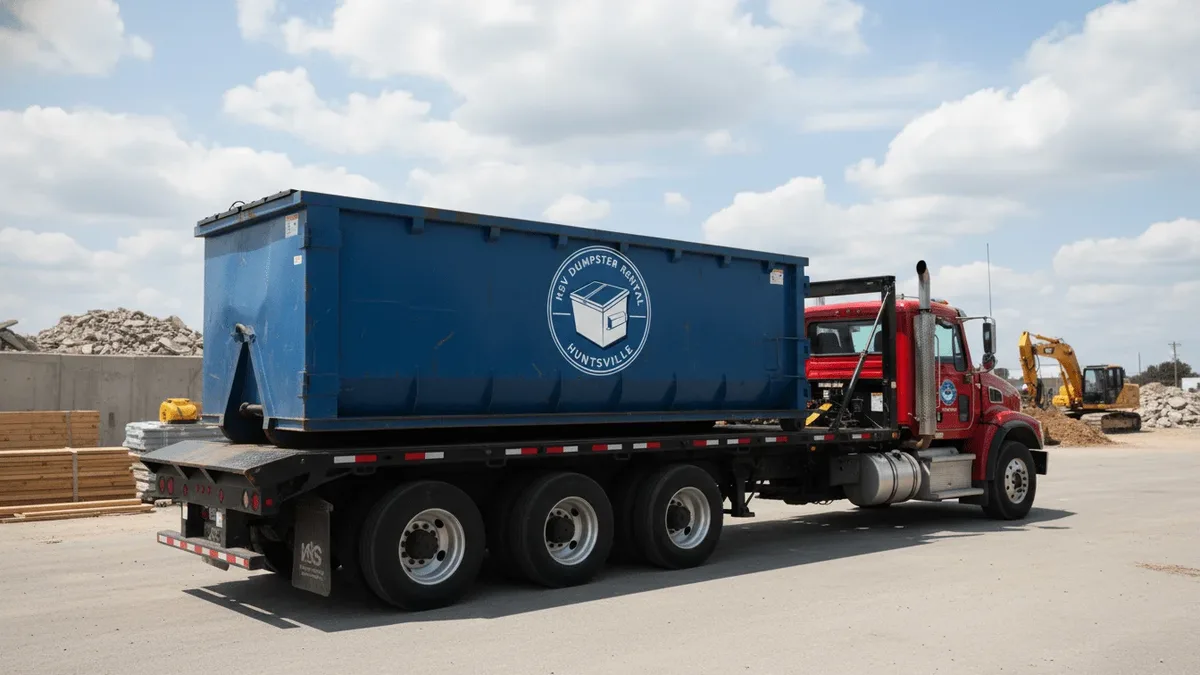
Construction and demolition debris is a different animal from a household cleanout, and it trips up the sizing conversation more than almost anything else we deal with. A contractor or homeowner tackling a remodel, an addition, or a teardown is usually thinking in square footage or room count — but the number that actually determines your dumpster size and cost is weight. Here's how to think through a job-site container the right way, from sizing to sorting to loading.
Every container has both a volume capacity, measured in cubic yards, and a weight allowance tied to that size. For light, bulky material — framing offcuts, drywall scraps, packaging, insulation — volume is usually the limiting factor, and you'll fill the box before you're anywhere near the weight limit. For dense material — concrete, brick, block, tile, dirt, roofing shingles — it's almost always the reverse: the container hits its weight allowance while it's still visibly half-empty. Sizing a construction job around square footage alone, without accounting for which side of that line your debris falls on, is the single most common way a project ends up needing an unplanned second container or an unexpectedly heavy load.
If your project involves any of these, plan on sizing down from what pure square footage would suggest, or splitting heavy material into its own dedicated load:
For these materials, a dedicated, correctly-sized container for the heavy load — separate from lighter general debris where possible — is usually the more cost-predictable approach.
Wood framing and offcuts, drywall scraps, cardboard and packaging, and insulation are all bulky-but-light — these fill a container's volume well before they threaten its weight allowance. New-construction cleanups and interior remodels that generate mostly this category of debris can often go with a larger container sized for volume rather than weight, since the risk here is running out of room, not running over the limit.
Where practical, keeping heavy and light debris in separate loads — or at least being deliberate about not burying dense material under bulky-but-light debris — makes for a more predictable job. A few practical habits:
For general construction and demolition work, our construction dumpster rental and demolition debris services cover the full range of sizes. As a rough starting point: smaller remodel and renovation debris often fits a 20-yard dumpster, larger renovation or new-construction cleanup often calls for a 30-yard dumpster, and full demolition or large commercial job sites often need a 40-yard dumpster — but all of that shifts depending on how much of your debris is heavy versus light. Our general sizing guide, what size dumpster do I need, covers the full range if you want the bigger picture first.
If your project is generating concrete, brick, or block as the primary or only material — a driveway tear-out or a foundation demo, for example — that's often better served by a container sized specifically for heavy debris rather than a general-purpose box. Our concrete and heavy debris service is built around exactly this kind of load, where weight, not volume, drives every part of the sizing conversation.
Because weight is such a large factor in construction debris, sizing by phone with a real description of your project — what's being torn out, roughly how much, and whether it leans heavy or light — is the most reliable way to land on the right container the first time. That also feeds directly into an accurate quote; see our guide to what drives dumpster rental cost for how weight, size, and material type come together on your final rate. Call HSV Dumpster Rental Huntsville at (938) 666-6548 to talk through your job site and get a size and flat rate that actually fits.
FAQs
Construction and demolition debris often includes dense material like concrete, brick, tile, or shingles, which hits a container's weight allowance well before it fills the box. Household junk tends to be bulkier and lighter, so the same size container behaves very differently depending on which type of debris fills it.
It's usually better to keep them separate when possible. Concrete is dense and will drive up weight fast, while wood framing is bulky but light. Mixing them makes it harder to predict weight, and dense material buried under lighter debris can also make loading less efficient.
Concrete and masonry demolition is dense enough that a container is often better sized for weight rather than volume — a smaller box may hit its weight allowance before it's visibly full. Describing the square footage and thickness on a call helps us size it accurately.
It can be worth it. Demolition debris tends to run heavy while finish-out debris (drywall scraps, packaging, offcuts) tends to run light and bulky. Scheduling separate containers for each phase often gives more predictable sizing and cost than one box for the whole project.
Concrete, brick, block, tile, dirt, and roofing shingles are dense and heavy for their size. Framing lumber, drywall, packaging, and insulation are bulky but light. Most job sites generate a mix — tell us the breakdown on your call and we'll help size the container around it.
Ready when you are
Call and you will speak to someone local who knows the streets, the permit rules and which box actually fits your lot. Flat rate quoted up front.
Keep reading
Clearing out a family home is rarely simple, and it's almost never just about the stuff. Here's a practical checklist to help you sort, decide, and size the job — one step at a time.
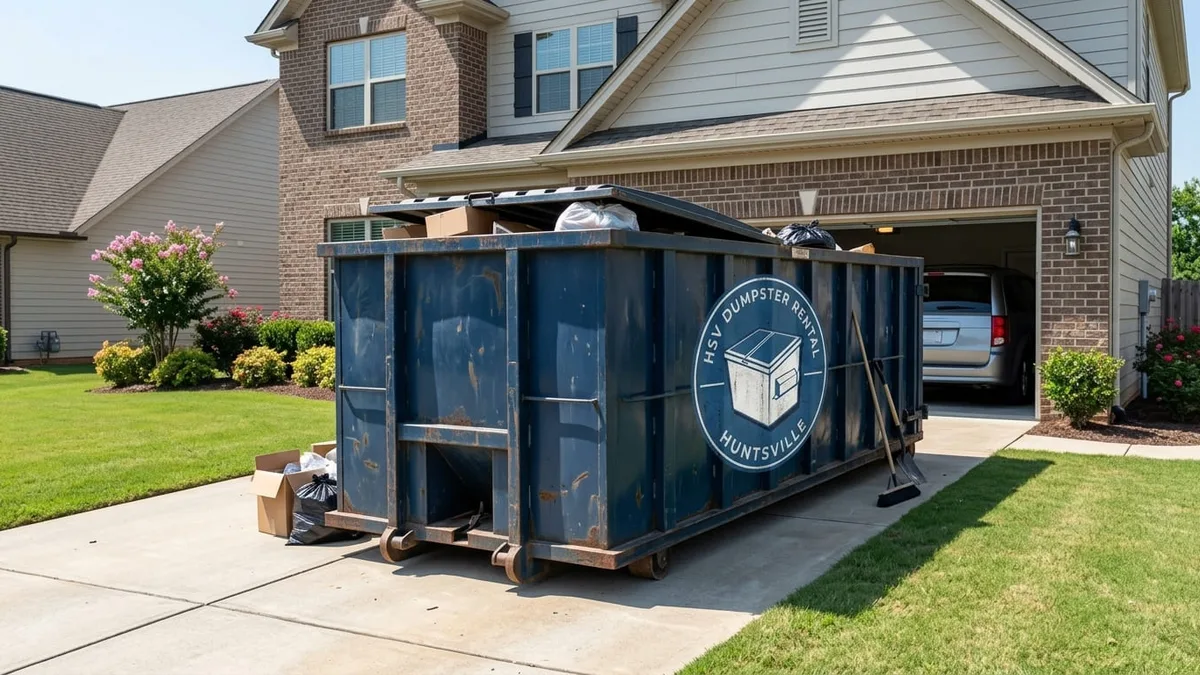
Roofing debris is deceptively heavy for its size, which means squares only tell half the sizing story. Here's how squares, layers, and weight fit together — and which container actually fits your tear-off.
North Alabama's real seasonal weather risk is tornadoes and severe thunderstorms, not flooding — and it's local history, not an abstraction. Here's how that shapes the way we schedule deliveries.